


Capturing Major Demand in “Cislunar Security” and “Lunar Infrastructure”Centered on Expanding Its Global Business Foundation
TOKYO—November 13, 2026—ispace, inc. (ispace) (TOKYO: 9348), a global lunar exploration company, today announced its financial results for the second quarter of the fiscal year ending March 2027.
For details, please refer to the FY2027 Q2 (interim period) financial results report prepared in accordance with Japanese GAAP (consolidated), available on the company’s investor relations website. The FY2027 Q2 earnings presentation, recording of the earnings briefing, and transcript of the briefing will also be published sequentially on the same site.
IR Website: https://ir.ispace-inc.com/jpn/news/
As momentum accelerates worldwide toward lunar exploration and the development of lunar infrastructure, ispace is expanding its business opportunities by targeting significant demand in two key areas: Cislunar Security and Lunar Infrastructure.
In the field of cislunar security, demand is increasing, particularly from the U.S. Space Force, for capabilities such as surveillance, communications, and navigation in cislunar space, the region between Earth and the Moon.
To address these needs, ispace plans to launch its own lunar orbiter as Mission 2.5 as early as 2027. The company aims to demonstrate and commercialize on-orbit services including communications and Space Situational Awareness (SSA).
ispace plans to deploy at least five of its own satellites by 2030 for its Lunar Connect Service. Ahead of today’s financial results announcement, ispace also announced a new Memorandum of Understanding with KDDI aimed at securing Japan’s independent communications capabilities on the lunar surface and in cislunar space. The companies will leverage their respective technologies, infrastructure, and operational capabilities and customer bases to develop communications networks and jointly provide services.
In the lunar infrastructure sector, NASA is expanding commercial lunar transportation programs, while Japan and Europe continue advancing lunar exploration and infrastructure development initiatives.
ispace-U.S., the company’s U.S. subsidiary, has been selected as an awardee under NASA’s Commercial Lunar Payload Services 2 (CLPS 2) Indefinite Delivery/Indefinite Quantity (IDIQ) contract. This provides ispace-U.S. with the significant opportunity to compete directly as a prime contractor for future task orders issued by NASA.
The company views this selection as a reflection of NASA’s recognition of its technical development and mission operations capabilities demonstrated through Mission 1 and 2, marking an important new stage in the growth of its U.S. business.
The total contract ceiling for all CLPS 2 awardees is US$10 billion, and ispace-U.S. will continue pursuing opportunities to secure individual task orders under the program.
In Japan, the “ULTRA” lander for Mission 3, scheduled for launch in 2028, has successfully completed its Preliminary Design Review (PDR) after incorporating the planned engine change into the overall system design.
The project will next proceed through the Critical Design Review (CDR) phase before moving into flight model manufacturing.
The company is also strengthening its technology and procurement foundations for future continuous lunar transportation, including adoption of engines produced by Nammo, which have a proven track record of successful lunar landings.
Summary of Financial Results
- FY2027 Q2 Results
Income Statement
ispace maintains its FY2027 Project Revenue forecast of ¥9.0 billion, representing an increase of more than 50% year-over-year. Project Revenue, which combines revenue and subsidy income, is expected to be concentrated in the second half of the fiscal year, with substantial progress toward the full-year forecast still to come. Meanwhile, the impact on profitability has been concentrated in the first half, primarily due to the significant impairment loss recorded in Q1.
Project Revenue
- ¥1.675 billion*
This is a trial calculation including approximately ¥1.1 billion in subsidies already received through Q2 as revenue. Actual accounting recognition is expected at fiscal year-end. Full-scale receipt of subsidies is expected to be concentrated in the second half of the fiscal year as Mission 4 development progresses.
Revenue
- ¥569 million
- Decreased year-over-year.
- In the previous fiscal year, revenue from Mission 2 and the former Mission 5 (CP-12) was recognized.
- Following the signing of the MAGPIE contract in September, substantial revenue recognition is expected to be concentrated in the second half as Mission 4 development advances.
Gross Profit
- Loss of ¥5.207 billion
- Decreased year-over-year.
- Primarily due to an impairment loss of approximately ¥3.7 billion recorded in cost of sales during Q1, resulting from the integration of lander models and engine changes announced in March 2026.
Net Income/Loss
- Net loss of ¥10.451 billion
- Declined year-over-year mainly due to the above impairment loss.
- Income from the SBIR subsidy program and the Space Strategy Fund subsidy, expected to be received during the current fiscal year, is expected to be recognized as non-operating income in a lump sum during Q4.
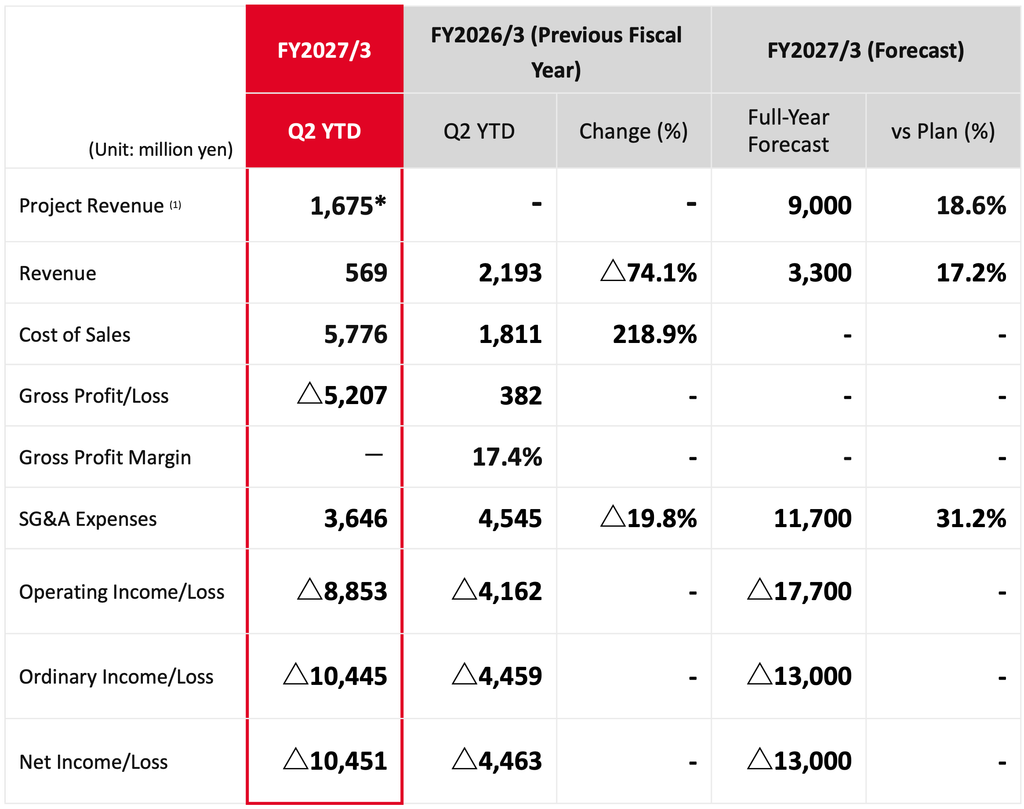
Q2 Financial Results for the Fiscal Year Ending March 2027
- Balance Sheet
Cash and Cash Equivalents
- ¥22.585 billion
- Stable liquidity maintained, consistent with the previous year.
Advance Payments
- ¥9.075 billion
- Although reduced by the ¥3.7 billion impairment loss, advance payments increased during Q2 primarily due to procurement activities for Mission 3.
Interest-Bearing Debt
- ¥30.888 billion
- The company secured a new ¥3.0 billion loan from Shizuoka Bank in September.
Net Assets
- ¥5.731 billion
- Net assets decreased partly due to the Q1 impairment loss of approximately ¥3.7 billion.
- Strengthening financial stability remains an ongoing management priority.
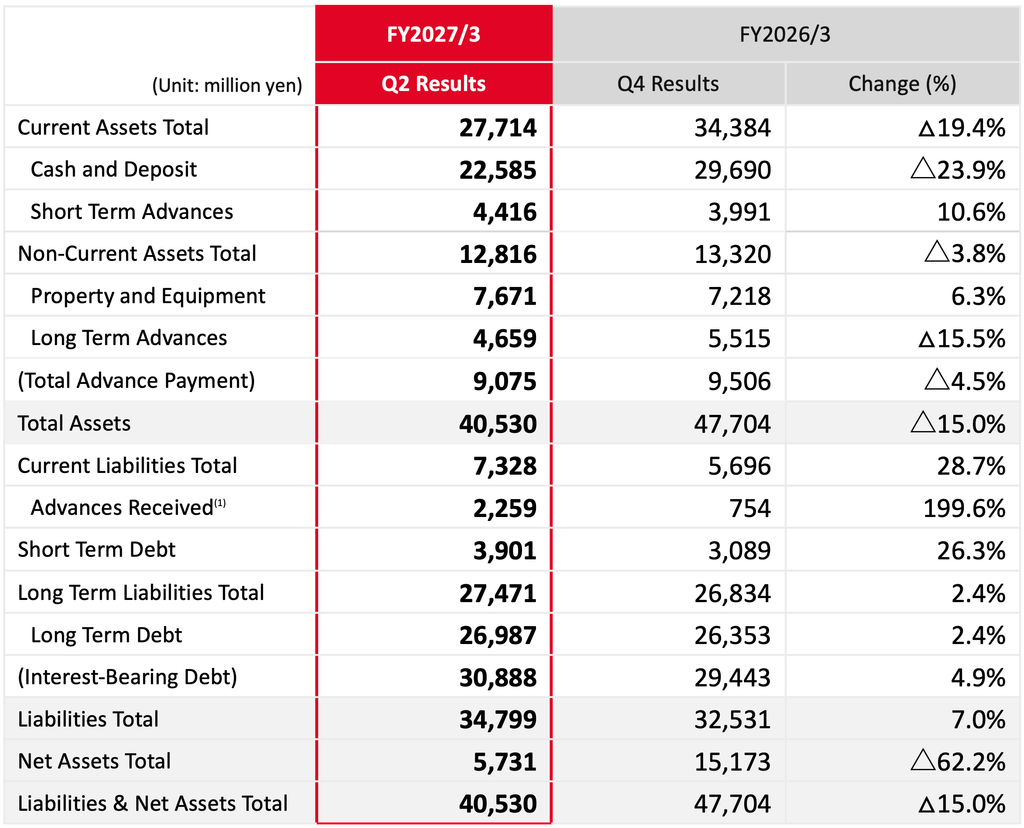
Q2 Financial Results for the Fiscal Year Ending March 2027
For details regarding the FY2027 interim cash flow statement and related information, please refer to the full-year financial reporting materials.
Statement of Jumpei Nozaki, CFO & Executive Business Director of ispace
“As large-scale market for lunar infrastructure begins to take shape, led by the United States, the selection of our U.S. subsidiary as a prime contractor eligible to participate directly in NASA’s CLPS 2 program represents an extremely significant milestone.
This presents a major opportunity to translate the lander development technologies we have cultivated through our two missions, together with our business foundations in Japan, the United States, and Europe, into substantial revenue opportunities.
At the same time, we must not overlook the emerging growth in the field of cislunar security. Strengthening defense capabilities and securing independent communications capabilities in cislunar space, between Earth and the Moon, will become increasingly important national priorities.
We remain committed to achieving profitability while balancing investments in future market growth with financial discipline,” said Jumpei Nozaki, CFO & Executive Business Director of ispace .
###
About ispace, inc. (https://ispace-inc.com)
https://ispace-inc.com/https://x.com/ispace_inc ispace, a global lunar resource development company with the vision, “Expand our planet. Expand our future.”, specializes in designing and building lunar landers, rovers, orbital transfer vehicles, and relay satellites. ispace aims to extend the sphere of human life into space and create a sustainable world by providing high-frequency, low-cost lunar transportation and related services. The company has business entities in Japan, Luxembourg, the United States, and Saudi Arabia, with more than 300 employees worldwide. For more information, visit: www.ispace-inc.com and follow us on X: @ispace_inc.